Every Chair Is a Decision: Inside the Quiet Craft of Delegation Dinner Diplomacy
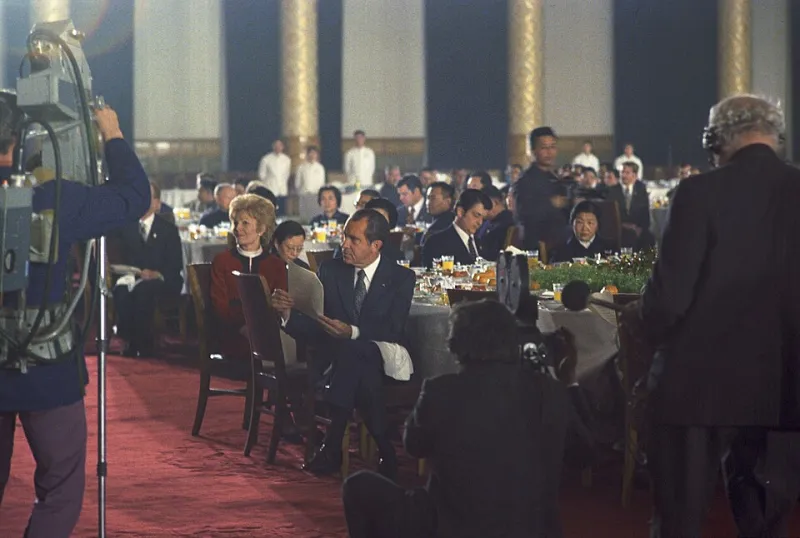
Photo: President (1969-1974 : Nixon). White House Photo Office. 1969-1974, General Services Administration. National Archives and Records Service. Office of Presidential Libraries. Office of Presidential Papers. 1/20/1969-ca. 12/1974, Public domain, via W
The menu was finalized three weeks ago. The wine was locked down a month before that. But the document that keeps Elena Marsh up at night is a single sheet of paper, revised eleven times, that most guests will never see: the seating chart.
Marsh has planned official dinners for trade delegations, ministerial visits, and Fortune 500 summits on four continents. In her telling, the seating chart is not logistics. It is strategy — the closest thing the business world has to a chess opening, played out in chairs instead of pieces.
"People assume a dinner is a dinner," she says. "It isn't. A dinner is a room where you've decided, in advance, exactly who talks to whom. If you get the chart wrong, you've spent forty thousand dollars on catering and produced nothing."
The Invisible Work Before the First Course
The process begins weeks out, when Marsh's team builds what she calls a "tension map" — a rundown of every attendee's rank, priorities, grudges, and ambitions. Protocol tradition, particularly the European and Asian conventions that govern most international gatherings, dictates hierarchy: hosts and guests of honor at the center, alternating across the table so conversation can flow without anyone shouting past a neighbor.
But tradition is only the starting point. The real work is in the exceptions.
A junior trade officer who happens to speak fluent Mandarin might be seated beside a senior Chinese counterpart, overriding rank entirely. Two executives from rival firms might be deliberately separated — or, just as deliberately, placed together, because the host has decided it's time they talked. A notoriously quiet billionaire might be parked next to a gregarious founder specifically so the founder can draw him out.
"Every seat is a message," Marsh says. "Whoever drew the chart has an opinion about you. And if you know how to read it, the chart tells you what the host wants to happen tonight."
The Trade-Offs No One Discusses
The calculus gets harder with every constraint. Marsh describes three that come up constantly:
Proximity versus prestige. The seat next to the guest of honor is the most coveted — and often the least useful. Honorees get pulled away, greeted, photographed. The seat two places down, close enough to converse but free of ceremonial duty, is frequently where the real conversation happens. Veterans sometimes call this the "working seat."
Rank versus chemistry. Protocol says the most senior people sit together. Experience says the pairing that produces a deal is often senior executive plus the operational person who will actually implement it. Hosts must choose which outcome they're optimizing for.
Rivalry versus avoidance. Seating two competitors apart avoids an awkward evening. Seating them together, with a skilled neighbor as a buffer, can begin a thaw. Marsh has done both. "Avoidance is the safe play," she notes. "Engineering a conversation is the ambitious one. You only attempt it when you've done your homework."
What American Executives Can Learn From the Chart
US business culture tends to treat seating as an afterthought — first come, first served, or a loose attempt to keep teams together. Marsh argues that's a missed opportunity, and that executives attending international summits should approach the table the way diplomats do.
Her practical guidance:
Read the chart before you sit. If a seating plan is posted or printed, study it. Your placement tells you the host's intent. A seat near the center signals investment in you; a seat at the periphery means your work tonight happens elsewhere — perhaps at the bar afterward.
Choose the working seat when you can. If seating is open, resist both the head of the table and the safe corner. Position yourself within easy conversation of two or three people you don't already know, ideally including one who outranks you and one who doesn't.
Be someone else's good placement. The most valuable guests at any dinner are the ones who make their neighbors look and sound smart. Marsh's shorthand: "The chart can put you next to power. Only you can make that seat worth something."
Send your own signals. When you host, remember that your guests are reading your chart the same way. A thoughtfully arranged table is a quiet statement that you understand the room — and the room notices.
The Follow-Up Is Part of the Play
Marsh's final rule happens after the plates are cleared. Within forty-eight hours, she expects her clients to have sent notes to the people they sat with, referencing one specific thing from the conversation. "The seating chart opens the door," she says. "The follow-up walks through it. Most Americans never do either part deliberately."
At the next Global Business Summit, thousands of chairs will be arranged across dozens of dinners, receptions, and private rooms. Most delegates will sit down without a second thought. The ones who treat every chair as a decision — theirs and everyone else's — will leave with more than a full stomach.
They'll leave with the conversation the host, or the guest, engineered on paper weeks before.