Own the Room, Not the Badge: The Quiet Rise of Summits Within the Summit
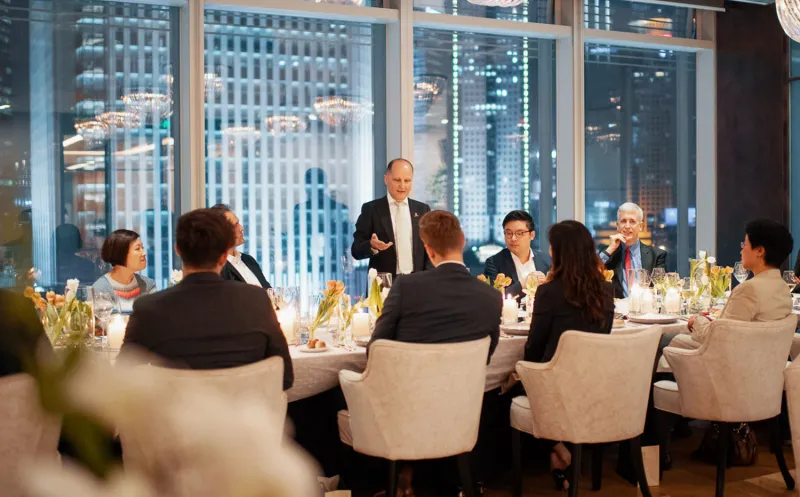
Photo: private business dinner hotel suite executives networking event, via assets.executivecentre.com
Here is an uncomfortable truth about major international conferences: the most valuable conversations happening on-site often have nothing to do with the official agenda. They happen on the 14th floor of a hotel across the street, behind a door with a handwritten sign, at a dinner where nobody is wearing a lanyard.
A growing cohort of American founders has stopped treating this as a workaround and started treating it as a strategy. They attend the summit — but they host their own.
The Satellite Event, Formalized
The practice has old roots. Diplomats and dealmakers have long understood that the margins of a big gathering are where the real business gets transacted. What's new is how deliberately US founders are now engineering it: private dinners for twelve, morning roundtables in rented suites, invite-only panel discussions scheduled against the official programming to pull exactly the people they want.
The logic is straightforward. At a 10,000-person conference, even the most skilled networker is competing for attention with 9,999 others. In a room of fifteen hand-selected guests, you're not networking — you're convening. One is an activity. The other is a position of authority.
"When you host, the room's gravity works for you instead of against you," as one Boston-based founder who runs an annual invite-only dinner during a major European tech summit told us. "Everyone who walks in already knows you're the person who brought them together."
The Bootstrapper's Playbook
The stereotype is that this requires corporate hospitality budgets. It doesn't. Founders on startup budgets report pulling off credible satellite events for $3,000 to $8,000:
- Skip the venue, book the suite. A large hotel suite or a restaurant's private room costs a fraction of official event space — and you don't need the conference's permission to use it.
- Breakfast beats dinner. Morning slots face less competition, cost less, and attract executives who protect their calendars in the evenings.
- Curate ruthlessly. Fifteen of the right people outperform fifty of the approximate ones. The invite list is the product.
- Partner for credibility. Co-hosting with a law firm, an accelerator, or a trade association splits costs and borrows institutional weight.
- Time it deliberately. Schedule against the weakest block of the official agenda, or before the conference opens entirely.
The Traps Worth Knowing About
The legal and logistical pitfalls are real, and they catch first-timers every year.
Anti-corruption rules. If any guest works for a foreign government or state-owned enterprise, hosting them for dinner can trigger FCPA scrutiny. US companies with international exposure should clear guest lists through counsel.
Venue restrictions. Some conferences contractually restrict partner events during official hours, and some hotels have exclusivity agreements with the summit itself. Read the fine print — or host off-property.
The no-show problem. International travel, jet lag, and overlapping events mean a 30% no-show rate is normal. Over-invite accordingly.
Local compliance. Alcohol licensing, food safety, and liability rules vary by country. A local event partner or DMC is usually worth the fee.
Why This Matters for the Official Agenda
Satellite events aren't a rejection of the main conference — they're a compliment to it. The summit provides the concentration of talent and intent; the satellite event provides the intimacy and control. The savviest operators use both: official keynotes for signal and credibility, private rooms for conversion.
For American founders planning next year's international circuit, the question is shifting. It used to be "Should I attend?" Now it's increasingly "Should I host?" And for those who answer yes, the badge around their neck is the least important thing they'll wear all week.