Staffing for Language: The Quiet Hiring Frenzy Behind America's Summit Season

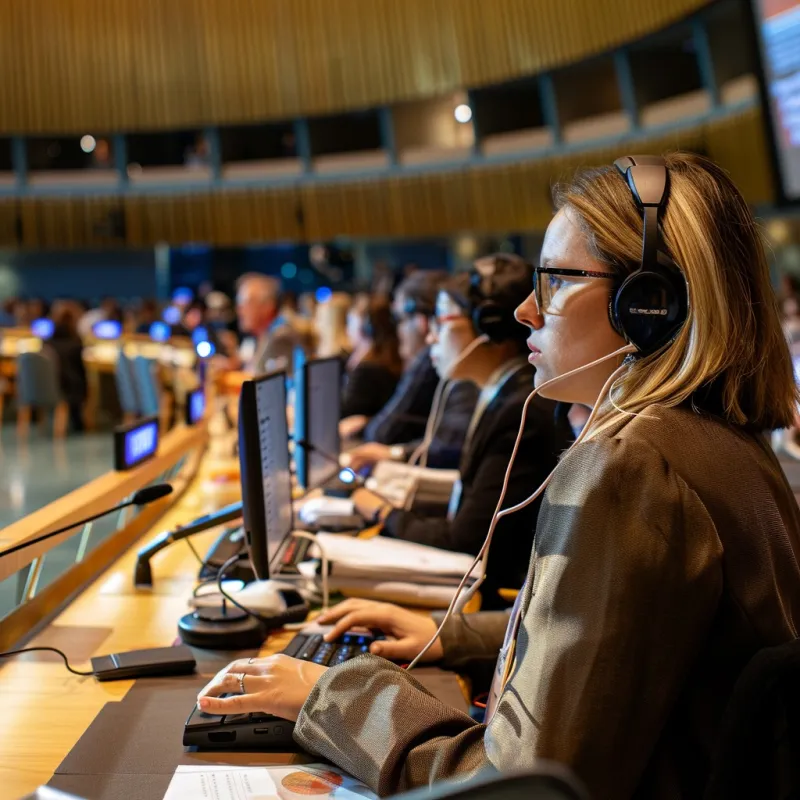
Photo: business interpreter translating meeting international conference executives, via www.kaplaninterpreting.com
When a Midwestern manufacturer booked its first delegation to an Asia-Pacific trade summit last year, the logistics team budgeted for flights, hotel blocks, and booth fabrication. What they didn't budget for was language. By day two, executives were relying on the goodwill of a competitor's bilingual associate to sit in on a negotiation with a Vietnamese distributor. The deal closed — eventually — but the company learned an expensive lesson that is now reshaping hiring plans across corporate America.
The demand for multilingual talent around summit season has quietly become its own labor market. Recruiters informally call it the interpreter economy, and it extends well beyond the traditional conference booth translator.
From Booth to Boardroom
A decade ago, language support at a global summit meant a name-tagged interpreter stationed at a convention center kiosk. Today's expectations are far more integrated. Companies increasingly want multilingual professionals embedded in the delegation itself — people who can read the subtext of a negotiation over dinner, flag a cultural misstep before it becomes a diplomatic incident, and follow up with prospects in their native language within hours of a hallway conversation.
The distinction matters. Conference interpreting is a craft with its own professional standards, and skilled simultaneous interpreters remain in short supply for specialized fields like fintech, pharmaceuticals, and energy. But the fastest-growing segment is what staffing firms describe as "deal-support bilinguals" — professionals fluent in both a second language and the commercial context in which it will be used.
What the Market Pays
Compensation data tells the story of a seller's market. Freelance conference interpreters with technical expertise routinely command day rates in the $800 to $1,500 range during peak summit windows, with top-tier practitioners in rare language pairs — Korean-to-English legal specialists, for example — earning considerably more. Embedded bilingual deal-support staff hired on seasonal contracts often see premiums of 20 to 40 percent over their monolingual peers in equivalent roles.
For permanent hires, the calculus shifts. Talent acquisition leaders at several Fortune 1000 companies report that bilingual capability has moved from a "nice to have" to a scored criterion in international-facing roles. One Midwest-based logistics firm now weights language proficiency alongside P&L experience when hiring for its global accounts team.
The Performance Gap
The rationale is straightforward: deals stall when nuance is lost. Executives who have worked both sides of the language divide describe a familiar pattern — a promising first meeting conducted through a third party, followed by a slow fade in the follow-up because no one on the home team could sustain the relationship in the prospect's language.
Firms that staff for language report the opposite arc. Rapid follow-up in a prospect's own language signals commitment in a way no slide deck can. In markets where relationship-building precedes contracting — much of East Asia, Latin America, and the Gulf — that signal is often the difference between a handshake and a contract.
There is also a risk-management dimension. Miscommunication at international events can carry regulatory and reputational consequences, particularly in sectors with cross-border compliance obligations. A bilingual staffer who catches a mistranslated term in a memorandum of understanding is performing a function no legal review after the fact can replicate.
Building the Bench
For companies planning summit participation, the practical question is whether to rent or build language capability. The rental route — freelance interpreters and short-term cultural liaisons — offers flexibility but requires early booking, as the best practitioners are contracted months ahead of marquee events. The build route — hiring bilingual professionals permanently — costs more upfront but compounds in value across every subsequent market engagement.
A middle path has emerged at some US multinationals: pairing one professional interpreter per delegation with a rotating bench of bilingual employees who receive stipends and event roles in exchange for informal liaison duties. The approach builds internal capability while keeping fixed costs contained.
An Undervalued Asset
American business has historically treated English as a default export. That assumption is eroding as global summits diversify and as delegations from emerging markets arrive with sophisticated multilingual teams of their own. The companies thriving in this environment are those that stopped treating language as an afterthought and started treating it as infrastructure.
Summit season will come around again next year. The organizations that staffed for language this time will be the ones signing the deals — and the ones setting the pace for everyone still scrambling to find an interpreter in the airport arrivals hall.